 I had hoped to write about my successful homemade experiments with both makjang and kochujang. Makjang, an “instant” dwaen jang or soybean paste, ended up growing a layer of nice white fuzz. I probably could’ve salvaged it, but why risk it? I made another attempt and will follow up with a post on that later.
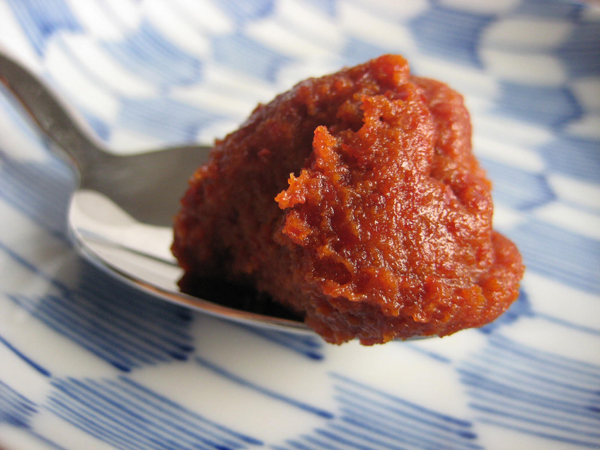
On the other hand, my homemade kochujang was a success. Kochujang is a fermented hot red pepper paste and is an essential Korean ingredient that is used in soups, jigaes, and sauces. As well as dishes like my Sloppy Jaes and ddukboki!
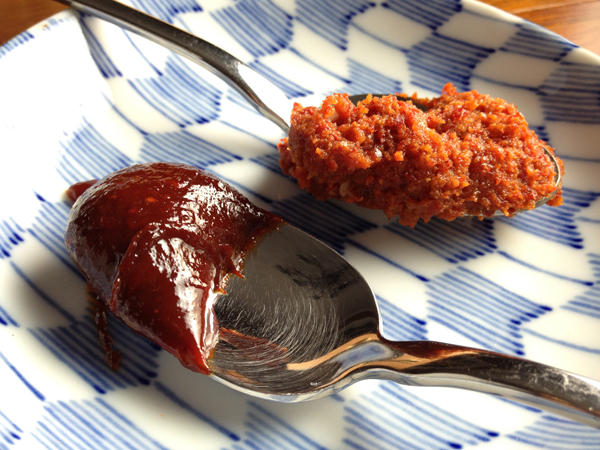
Each region or province in Korea had their own version of kochujang. And each household within that region had its own kochujang. Now this condiment is widely available at Korean grocery stores. They’re usually found in red plastic containers or stout wide-mouthed jars. The colors range from a deep dark brick red to a bright red and the consistency is usually that of a thick jam or toothpaste.
This batch came out a tad bit on the salty side, but since the maturing process takes a bit of time and attention, I probably won’t make another attempt until next summer or fall. For now, this batch totally works once I make small adjustments to my recipes.
The process is long, tedious, but simple. Don’t be surprised if you start to develop a relationship with your jar of fermented paste…and give it name (Little Guy)…and start talking to it.
Anyway…
Back in August, I mixed all my ingredients and crossed my fingers. Every sunny day I brought my Little Guy outside on the back deck and brought him back in every night. On cloudy and rainy days I left the Little Guy on my kitchen counter. I coddled the Little Guy everyday for about a month and a half. He was my baby.
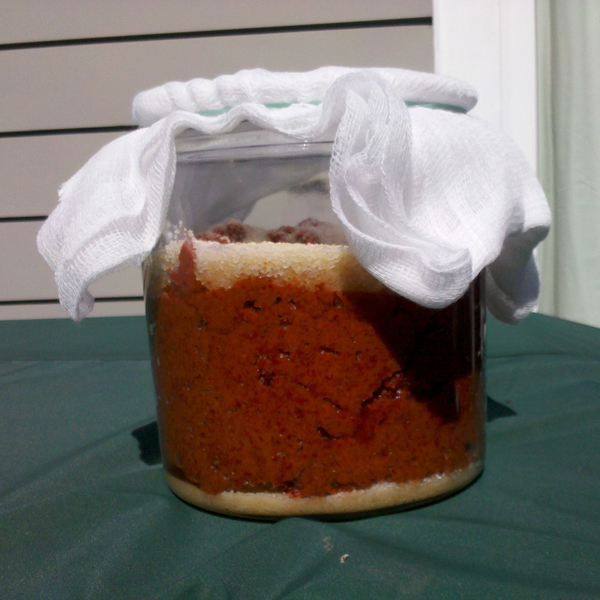
Sunbathing…
It was worth the wait. The flavor is much more complex and deep, very much unlike the store-bought syrupy sweet goo. The homemade kochujang has a smoky heat with a bit of tang and a texture that is thick and pasty. I can’t wait to try all my recipes with my homemade kochujang.
Kochujang
Adapted from Growing Up in a Korean Kitchen by Hi Soo Shin Hepinstall
Yields about a quart
1 1/2 cups barley malt powder
5 cups water
2 cups sweet rice flour
2 cups kochugaru (hot red pepper powder)
1 cup meju powder (soybean)
1 1/2 cups kosher salt (I used Morton’s Kosher Salt)
1 – In a bowl, combine the malt powder and water. Stir to dissolve. Let stand overnight in a warm place. I kept mine in an electric rice cooker on the “keep warm” setting.
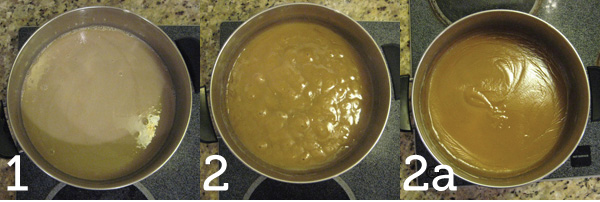
2 – Strain the mixture into a heavy stockpot, add the sweet rice flour, and dissolve well. Bring to a boil and simmer over low heat until its volume is reduced by one-third to one-half. 2a – Cool and set aside.
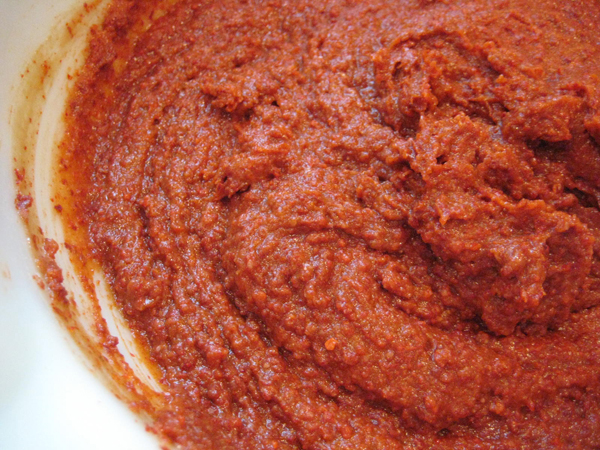
 3 – In a large bowl, combine, the kochugaru, meju powder, rice and malt paste, 3/4 cup salt. Mix thoroughly with a wooden spoon. Cover the bowl with a kitchen towel and let stand overnight.
4 – Sprinkle half of remaining salt on the bottom of a clean, dry jar so that it covers the surface of the jar.
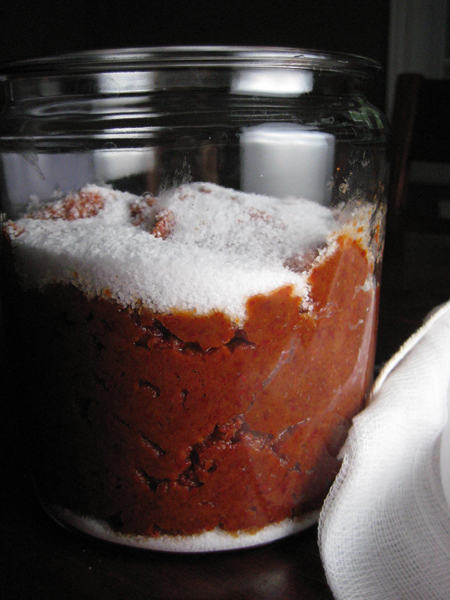
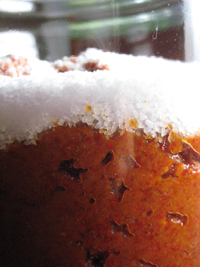 5 – Transfer the kochujang paste to the jar. Sprinkle the remaining salt on top and make sure the entire surface is covered to prevent mold growth.
6 – Leave about 2 inches of space at the top. Cover the jar with a gauze or cheese cloth. I folded the cheese cloth three times and secured it with a rubber band. It’s mostly to prevent debris and insects from getting into the jar. Cover with a lid. It does not have to be airtight.
7 – This is the tedious part. Sun-dry every day and cover with an earthenware top at night or just bring the little guy in. Do this everyday. Let the paste mature and ferment for at least 30 days.
8 – By the time it is ready, the salt has transformed into a hard crust. Scrape and discard the salt and only remove as needed.
9 – Can be stored in the refrigerator indefinitely.
Notes: This initial batch came out a tad bit salty so I plan to adjust the recipe to account for that by using less salt and trying Kosher Diamond Salt which is less saltier than Morton’s.
Also, I used to be able to order barley malt powder through HMart.com, but I’ve discovered that Bob’s Red Mill also produces it.
This half-gallon jar from Crate and Barrel worked perfectly for me.



I love any type of hot pepper or chili paste so kochujang is no exception. Sounds like you took such love and care of the “little guy” so no wonder it came out so tasty. Thanks for sharing this recipe as I’ve been wanting to make my own version of chili paste for awhile so it was an inspiration.
Just do it! Homemade is so much better! Looking forward to making another batch next summer. I might even make my own red pepper powder just to go that extra mile. I’ve been wanting to make sriracha too! Thanks for visiting!
Is there a substitute for Barley Malt powder? My husband is gluten intolerant and can’t have barley, rye or wheat. I’d really like to make this since I can’t buy it anywhere locally!
Hi Katie – I’ve asked a few GF chefs and experts for a substitution, but I think I stumped them. Next time I’m going to try a small batch without the malted barley and add sugar.
All these years, I never knew you could make gochuchang from scratch!
I hear that there are halmonis in NJ that make it in their homes and sell it! I also made makjang (instant dwaenjang) which I will post soon.
Very inspiring that you’ve made this on your own. Do you know long it keeps?
According to Hepinstall and my mom, it should keep indefinitely in the fridge! Are you going to try making it?
i am interested in trying this… one day. you know, when my giant plastic tub runs out!
Hi Jane – It will be worth it! Tastes so much better than the store-bought stuff.
Wow! You have no idea how many times I’ve seen folks on other blogs (like Maangchi’s or Aeri’s Kitchen) asking if they could make gochjang from scratch, and the bloggers scratching their heads! I applaud your efforts; it looks delicious!
This is definitely a project I need to dig into.
It’s fairly easy to put together, but the “babysitting” is a bit tedious. You should try it! It helps if you have a sunny outdoor spot.
i was wondering if you have tried making this without the malted barley, or at lest a different malted grain that doesn’t contain gluten. Beer is malted and typically contains wheat, however, i know there is gluten free beer which uses a different type of malted grain. if you haven’t experimented with this yet, do you think that it’d be expensive to experiment myself?
I am actually planning on experimenting with a gluten-free recipe. i have trying to reduce/eliminate my gluten intake for health reasons and am interested in coming up with a gluten-free recipe. My mom has told me that the kochujang her mom (my grandmoms) made never included malted barley so am very interested in recreating her recipe! you can wait for my version or I would love to see what you come with also!
Thank you so much for posting this recipe. I will use it as my guide for making my own! I’m going to attempt making a gluten free recipe using Juwar Flour (Sorghum). I will post the results on my blog and give you credit for providing the basis.
Thanks for stopping by. I can’t wait to see the recipe for your GF kochujang. I will be attempting a GF version also this summer!
Ok, so I don’t know the final results yet but the surghum flour maybe a little too thick to use and I’m not sure it is providing the same effect as the barley malt powder. It was “cream of wheat” like after setting all night. It did have a pleasant sweet smell and tasted like cereal. I ended up adding some liquid ( I chose rice wine) so that it would blend with the other ingredients. We’ll see how it goes but after making a backup batch with the barley malt, I’m thinking that it could be better to just increase the amount of fermented soy bean powder and omit the barley malt powder as a solution for making it GF? I’ll let you know what happens in 30 days and look forward to your GF version.
hmmm….not sure what the wine will do. maybe i would’ve tried salted water. are you putting it out in the sun as well?
I need to know for no 3. “Rice” & malt past. Is this need a bowl of rice or your referring to use the “Sweet Rice Flour” ?
It’s referring to the sweet rice flour. In the previous step, the barley malt powder and sweet rice flour are mixed together to make a paste so I just referred it as “rice and malt paste”.
Interesting. Should try this. Anything new about GF version?
no new updates on the GF version. I need to find the time to make another attempt. Thanks for stopping by…
Is glutinous rice flour the same thing as sweet rice flour? I want to make sure I’m using non GMO soy powder. Can I just make my own beans into powder?
Hi Amy, I’m having a go at your gochujang recipe! Some of my malt/rice paste burned on the bottom of the pot, how do I avoid that? And does the salt on the bottom of the jar get mixed INTO the paste post-fermentation, or just scraped off of?
I had the burner on low heat and stirred it periodically. The salt on the bottom gets mixed in. Although I scrape the salt off on the top before scooping. Good luck! Can you send me a picture…so curious how it looks!
Check it out, she looks just like your Little Guy!
I decided go proceed with the (slightly?) burnt paste–it tasted ok the next day when all the flavors melded together. Fingers crossed…
Jen! That looks awesome! 🙂 You’ll have to let me know how it tastes!!
Update time! 7 months later, a taste test. The paste was thick and smooth in a rustic way. The flavor was deep, but quite salty. I was thrown off by the fact that it lacked the sweetness I’ve always associated with gochujang, and realized the recipe never asked for sugar or a sweetener! I added about a cup of honey to balance the salt out, and upon mixing it thoroughly, it began to taste familiar.
Which leads me to question–is the introduction of sweeteners a modern idea? Is this salty-spice paste what true gochujang is supposed to taste like, before the mass marketing of sweet paste? Any insights appreciated!
https://www.instagram.com/p/3mVVMPoDc2/
This paste is not as sweet as the store-bought versions. The barley malt is the “sweetener” here.
What do you recommend straining the barley malt mixture with?
Hi Carolyn – I used a fine-mesh strainer and used a rubber spatula to push it through.
Yes you are correct, the term glutinous refers to the stickiness and not the protein gluten. Rice is naturally gluten-free. Would love to see how your kochujang turned out!